
As an architect, I have a limit to what I design. While I’m responsible for coordinating building systems such as HVAC, power, lighting, and structural framing systems, engineers actually design them. The question is when to get the engineers and their workforce involved. The answer is… it depends.
The Routine Project
If it’s a project type that we are used to working with such as a double-loaded classroom building I’ll usually wait until we have a fairly solid, or even schematically approved, design before bringing in mechanical, electrical, and structural consultants. After so many years of doing this, I can anticipate what the needs probably will be. I can leave room based on similar projects, conceptualize these systems, and get the architectural design to a point where handing it off doesn’t create a lot of surprises.
When That Doesn’t Hold Up
Often projects break these typical patterns. I’ve got one right now that’s a good example: a new building on a school campus with a second floor that needs to connect to an existing building at the same level… by way of a bridge that crosses a road, over topography that isn’t flat, with a drive underneath it that fire trucks need to navigate.
So what are the variables here. How shallow can that bridge structure be to give plenty of clearance underneath? While I have an intuition about it this I realized that I needed to bounce a few ideas off of someone. I brought in the structural engineer early (before schematic design was even finished) just for a preliminary check on whether the bridge was feasible given the existing conditions.
That project also pushed me to think harder, earlier, about mechanical systems. With a multi-story building and very little room around the perimeter, if the units end up on the roof, I must work out how they get back down to the first floor. The likely answer is carving out shaft space in the second floor early enough for ductwork, condensate lines, electrical, and everything else that has to travel from ground floor to the roof.
What Early Involvement Actually Looks Like
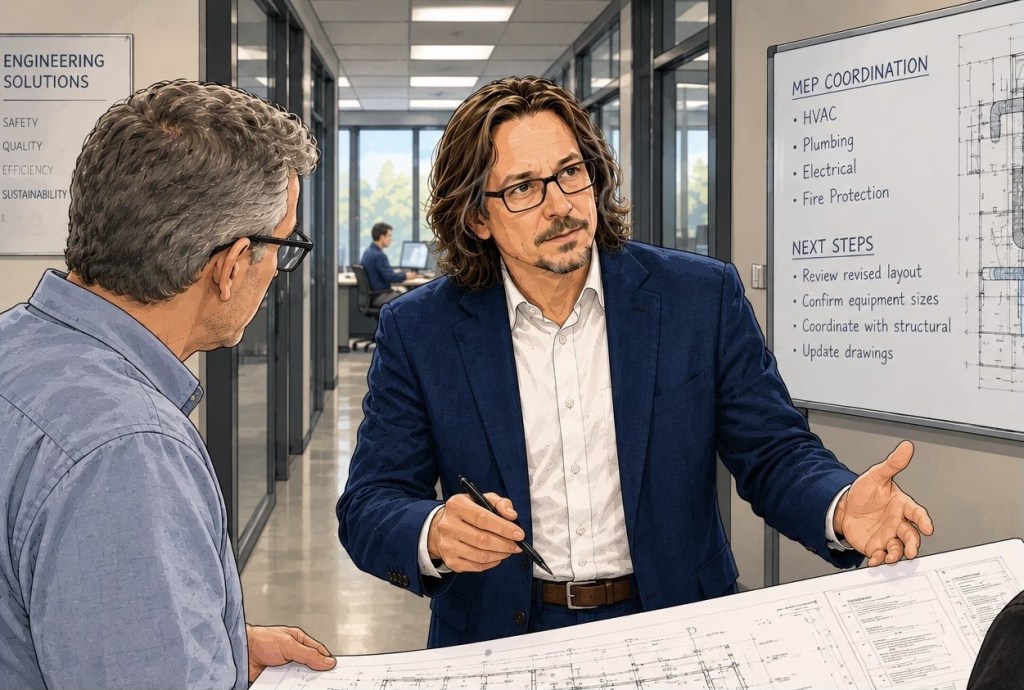
When I do bring engineers in early, it’s usually informal, often a phone call, sometimes just catching them while they’re in the office for another project. I try to be mindful that they’ve got their own deadlines and their own clients, so I don’t take up more of their time than the moment calls for. I’ll have sketches or schematic drawings on hand so they can see where I’m headed. It’s not uncommon for them to flag something I hadn’t thought of yet… which is exactly the point of bringing them in early in the first place.
Why Timing Matters
I try hard not to hand a design off to engineering consultants until it’s tightened up enough that I’m not going to be sending them major changes afterward such as a drastically different floor area or a shifted floor to floor height. A little back-and-forth or a few clarifying questions is absolutely expected but giant changes will cause lost time. Once I officially hand a project off, it’s rarely just one engineer looking at it. A full staff is running loads, doing calculations, and creating details and schedules necessary to price and get the project built. If I were send them significant changes after that point, I’m asking them to redo work they’ve already put real time into, and that’s not a great way to work with people whose time and expertise you depend on.
When is the Right Time
One of the clearest signals, for me, is when the owner has signed off on the preliminary or schematic design. That’s the line in the sand… not that the design can’t change from there, but that the owner and I agree on the direction. From that point, the project typically moves into design development, where the engineers and consultants start their own preliminary design work, and it becomes a back-and-forth discussion between the owner, the engineers, the architectural and interiors team to develop the design into something thoughtful and buildable.
A Final Thought
Part of doing this well, long-term, is simply respecting your consultants’ time. If you’re consistent enough with your delivery method, they don’t have treating every phone call as an emergency, they’re a lot more likely to help you out when you hit a crunch and need something pushed through. That kind of reciprocity is what makes a working relationship work, project after project.
 Dexter Architect
Leave a comment