
Here’s the scenario, we’re sitting in the OAC (Owner, Architect, Contractor) meeting and the Owner says, “Actually, could we….” At this point, the project has started, the slab is poured, maybe the structured is going up, or maybe the building is almost finished. What happens then?
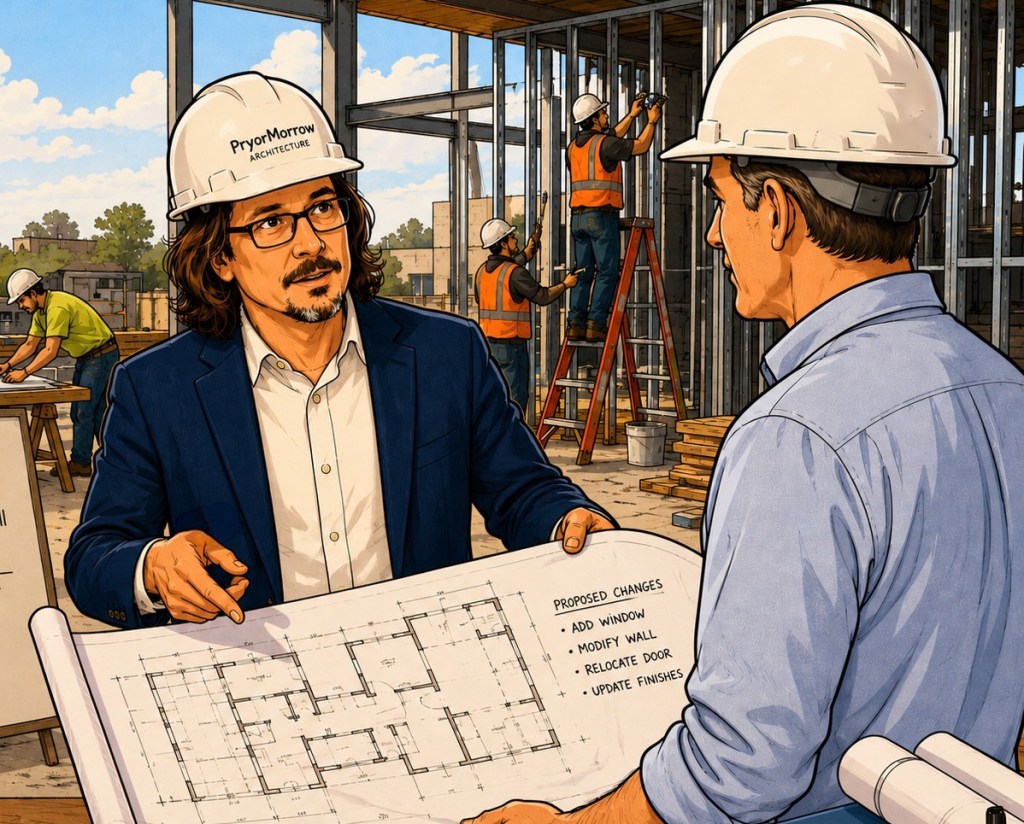
Sometimes it’s a small ask. Sometimes it’s a big one. Either way, the honest answer is… yes, you usually can make changes after construction starts… how easy, how expensive, and how disruptive that change is depends entirely on what you’re asking for, when you’re asking, and who’s paying. As a licensed architect in Mississippi who works on public projects like schools as well as private commercial work, this comes up fairly often. Here is what actually happens.
Minor Changes are Usually Painless
Not every mid-construction change is a crisis. On a recent school district renovation, lobby space with adjoining restrooms, the owner decided partway through construction that they wanted ground-faced concrete flooring in the restrooms instead of the ceramic tile we’d originally specified. On the same project, they also swapped a backlit acrylic sign with a printed logo for a CNC-cut metal logo, also backlit.
Neither of these caused us any real heartburn. Why? Because they were essentially swaps within money we’d already budgeted and dedicated to the project. The flooring change was close to a wash in cost, and the signage change fit within an allowance we’d already built into the contract. Changes like finish selections, tile types, wall coverings, faucets, door hardware, or even adding a door here or there generally fall into this low-friction category. They don’t dramatically alter the scope or intent of the project, so they’re easy for everyone (owner, architect, and contractor) to say yes to. Managing this type of change is a standard part of project administration.
Bigger Changes Can Cost You
Unfortunate not all changes are cosmetic. On another project, an owner decided partway through construction that a couple of storage rooms should instead of their original usages should become offices. These spaces would be occupied full-time rather than used for storage. That’s a meaningful change: storage rooms and offices have different heating and cooling requirements, so we had to add HVAC capacity to accommodate the new use. That resulted in a real monetary and added cost to the project.
Here is the part clients should be aware of: a change made mid-construction almost always costs more than the same change would have cost if it had been part of the original design. Once a contractor is involved, any change gets priced with his markup added, and his subcontractors add time and cost for re-mobilizing to do work that wasn’t in their original scope. I’ve had clients look at a change order price and wonder if they’re being taken advantage of… and I understand the instinct, but it’s rarely that simple. The contractor genuinely has more cost and disruption dealing with a change mid-stream than he would have had pricing it into the original bid.
This is exactly why I tell every client: if we can anticipate the need in design, before a contractor is involved, the cheaper and easier it is. If you and your architect have had thorough conversations during design and have really studied the project, there generally shouldn’t be many surprises once construction starts.
How a Change Gets Made
The process, step by step, once an owner brings a change to me:
- The request. The owner tells me what they want changed.
- RFP to the contractor. I send the contractor a request for proposal on that specific change.
- Contractor prices it. He distributes it to his subcontractors, who each price their piece, and he assembles a total cost and submits it back to us.
- Owner approval. If the price is acceptable, we typically issue a Construction Change Directive (CCD), which documents the intent and scope of the change and authorizes the contractor to proceed.
- Settling the money. If the change fits within an existing allowance in the budget, that amount gets deducted from the allowance on later pay applications, formalized later with a deductive change order that reconciles everything back to the owner. If it doesn’t fit within an allowance (or exceeds it) we issue an additive change order, which increases both the contract amount and, potentially, the contract time.
One tool that helps absorb minor surprises without derailing the budget: on many projects, we build in a latent conditions allowance, typically 2% to 5% of the budget , specifically to cover unknowns encountered once construction starts, particularly below-grade or existing-condition surprises. If we don’t end up needing it for that purpose, it can sometimes be redirected toward a change the owner wants, without changing the overall contract value. At the end of the project if these allowances are not used, the allowance amount is deducted from the contract sum as a credit.
There are Limits to Some Changes
On publicly bid projects, an architect and owner can’t simply decide mid-construction to expand the scope beyond what was bid. You can’t, for example, decide to add four more classrooms to a classroom building after the fact. That’s a significant enough change that it could have affected who bid the project and who may have been the low bidder, and it opens the door to real legal and procurement problems. Changes on public work need to stay within the intent of what was originally bid.
Public Clients Face an Extra Layer
If it’s private owner, changes tend to move fast, it’s an individual’s money, and they can make a decision on the spot. Public work is different. On school, municipal, or other publicly funded projects, decisions often have to go through a school board, county board of supervisors, or similar governing body, and those groups typically only meet monthly. Because board members aren’t involved in the project day-to-day, a change request usually requires a fair amount of explanation… who requested it, why the change needs to be made, and why it wasn’t caught earlier. These explanations can come under public scrutiny.
This is one more reason I push hard, especially on public projects, to resolve as much as possible during design. It’s far easier to have that conversation at a planning meeting than to explain a change order to a board after construction has started.
The Bottom Line
Yes, you can make changes after construction starts. Small cosmetic changes rarely cause problems. Bigger changes cost more (or are suspected to) than they would have during design, take longer to execute once a contractor and subcontractors are involved, and on public projects, they add a layer of governance and scrutiny that’s worth avoiding if at all possible.
The best way to avoid an expensive, drawn-out change order process isn’t to avoid changing your mind… it’s to make sure your architect has had the time and the conversations needed to get it right the first time, before the project ever goes out to bid.


Leave a Reply